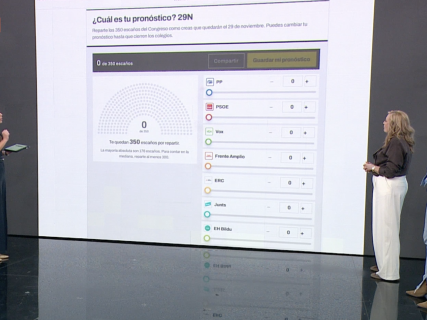









Success of the DEMÓCRATA electoral simulator, which doubles participants with the help of Atresmedia: watch how the votes evolve, cast yours and share it

The general elections of 29N already bring together almost 8,000 participants in the DEMÓCRATA tool that are used by readers and viewers of Atresmedia, 97.7% more than in the previous update. The PP keeps 136 seats in the median of the forecasts, the PSOE rises to 110 and Vox falls to 68: make your prediction and compare it with the others

Screenshot 2026 11 22 at 11.08.37

Screenshot 2026 11 22 at 11.08.37

Add DEMÓCRATA to Google

Ask FREN

Published

Last updated

5 minutes

Most read

Poder Digital · Carrera digital

La carrera digital de los candidatos

El Poder Digital de cada candidato a la Presidencia, de 0 a 100, desde junio · cambio en las últimas 4 semanas

30405060708090100julagoseptoctnovSánchez 93,8Montero 86,3Alvise 82,2Rufián 80,8Feijóo 79,1Abascal 78,4Colau 76,5Nogueras 58,0Valido 39,0
  1. 1Sánchez93,8▼ -0,2
  2. 2Montero86,3▼ -1,7
  3. 3Alvise82,2▼ -1,8
  4. 4Rufián80,8▼ -1,2
  5. 5Feijóo79,1▲ +0,1
  6. 6Abascal78,4▼ -3,6
  7. 7Colau76,5▲ +4,5
  8. 8Nogueras58,0▼ -4,0
  9. 9Valido39,0▼ -6,0

Pendientes de que su partido anuncie el candidato: Adelante, BNG, EH Bildu, EAJ-PNV y UPN.

Ver la carrera completa

Mide presencia e influencia en redes, no intención de voto.

The election betting ahead of the general election on 29 November is approaching 8,000 participants in the DEMÓCRATA simulator. The tool, which is also used by Atresmedia viewers, has almost doubled the number of “betting” entries that readers make on the Internet and then share on social media.

Participation nearly doubles, but the main distribution of the forecasts changes little. The PP keeps its 136 MPs, the PSOE moves up from 109 to 110, and Vox falls back from 69 to 68. The gap between the conservatives and the socialists narrows from 27 to 26 seats.

There is another shift in expectations: the percentage of participants who draw an absolute majority of PP and Vox drops from 83% to 80%. Eight out of every ten continue to consider that sum, although its weight decreases compared with the previous snapshot.

Nearly double the number of participants and two changes in the distribution of seats

The main novelty lies in the size of participation. The counter adds almost as many people as those who had already taken part in the first update, while the medians of the ten of the twelve candidacies shown remain the same.

Frente Amplio continues at ten seats; ERC, at eight; EH Bildu, at six; Junts, at five, and PNV, at four. BNG, Coalición Canaria, and Adelante Andalucía each maintain one, while Podemos remains at zero.

The only movements correspond to the PSOE and to Vox. This does not mean that an MP moves directly from one party to another: the tool calculates the median of each party separately, taking the central value of its ordered forecasts.

Democratic Simulator: This is how it would look on 29N Doubles the number of users’ predictions in 10 days
Predictions for the general elections: how seats change
Party Nov. 11 Nov. 22 Change
PP 136 136 0
PSOE 109 110 +1
Vox 69 68 −1
Frente Amplio 10 10 0
ERC 8 8 0
EH Bildu 6 6 0
Junts 5 5 0
PNV 4 4 0
BNG 1 1 0
Coalición Canaria 1 1 0
Adelante Andalucía 1 1 0
Podemos 0 0 0
Source: DEMÓCRATA tool used by readers and viewers of Atresmedia. Seats according to the median of each party. Voluntary participation: it is not a representative survey or an estimate of voting intention.

The PSOE reaches 110 seats and the PP maintains first position

The PSOE now reaches 110 deputies in the median of the predictions. That is one more than on November 11, but it still remains 26 seats behind the PP, which retains first position in this breakdown.

Vox stands at 68 representatives. The sum of the medians of the popular parties and Vox thus goes from 205 to 204 seats, 28 above the 176 that mark the absolute majority in Congress.

The change slightly reduces the distance between the two major parties and the sum of the right. However, it does not alter the order of the three main forces that the tool draws.

With respect to the July 2023 result collected in the previous information, the PP would have one fewer deputy, the PSOE would lose eleven, and Vox would gain 35. The 204 seats resulting from adding the medians of the PP and Vox would be 34 more than the 170 that both parties obtained then.

The share that anticipates a majority of the PP and Vox drops from 83% to 80%

The evolution of majorities provides a different reading of the party breakdown. Here, the tool counts how many participants build a Congress in which a certain combination reaches 176 seats.

The majority of the PP and Vox appears in 80% of the forecasts, three percentage points less than in the previous update. When SALF and UPN are added, the percentage reaches 82%, versus the previous 84%.

On the other side, the proportion that considers a majority of the PSOE and Frente Amplio remains at 4%. By incorporating Podemos, it rises from 4% to 5%, and by also including the 2023 investiture partners it goes from 12% to 13%.

The PP’s absolute majority alone remains present in 4% of the predictions.

80% includes a majority of PP and Vox Three percentage points less than in the previous update.
What majorities the participants of the 29N simulator forecast
Combination Nov. 11 Nov. 22 Change in points
PP on its own 4% 4% 0
PP + Vox 83% 80% −3
PP + Vox + SALF + UPN 84% 82% −2
PSOE + Frente Amplio 4% 4% 0
PSOE + Frente Amplio + Podemos 4% 5% +1
PSOE + Frente Amplio + Podemos and governing coalition partners from 2023 12% 13% +1
Source: DEMÓCRATA tool, screenshots from November 11 and November 22. Percentage of participants whose forecast grants at least 176 seats to each combination. The scenarios may overlap and do not add up to 100%. They are not election probabilities.

These percentages describe the participants’ scenarios: **they are not probabilities that each outcome will occur**. The combinations are also not mutually exclusive; the same forecast can surpass 176 deputies with several groups of parties.

Participants give the PP five more seats than the opinion polls reference

The simulator allows you to contrast the forecasts with another column: the average of the seat projections from the opinion polls shown by the tool, updated as of November 22.

The widest difference among the three main forces corresponds to the PP. Participants place it at 136 seats, versus 131 in that reference. The PSOE coincides at 110 and Vox receives 68, two more than the 66 from the opinion-polls column.

Therefore, the sum of the PP and Vox medians reaches 204 seats, compared with the 197 of the simulator’s demoscopic reference. There are seven seats of difference between two measures prepared in different ways.

Make your 29N tally: distribute the 350 seats and share it on WhatAspp and social networks

The simulator allows you to build your own Congress, adjust the deputies of each candidacy, and check which combinations reach the absolute majority. You can compare your allocation with the participants’ medians and with the opinion-polls reference that appears in the tool.

What’s your forecast for 29N?

Distribute the 350 seats, save your prediction, and share it on social media.

Open the simulator in full screen ↗

Open participation tool. Users' forecasts do not constitute a representative survey nor official election results.

The initiative has also gone through Espejo Público. Contributors such as Elisa Beni and Rubén Amón have used the simulator to present their predictions about the general elections.

More key points, information and questions with FREN

AI-GENERATED CONTENT

At what parliamentary stage is the processing of electoral reforms in Spain, and what would be the next steps for their approval?

As of November 23, 2026, there is no single electoral reform at a common stage: there are modifications already approved and others whose processing ended without becoming law. The main distinction is between the reform related to Formentera, already published, and the project on electoral debates and polls, which expired on October 6, 2026.

Status of the main reforms

  • Formentera: processing completed. Organic Law 2/2026, of June 30, adapts the Organic Law of the General Electoral Regime (LOREG) to the reform of article 69.3 of the Constitution. It modifies articles 161.2 and 165.2 to recognize Formentera as its own island constituency and assign it a senator. The Congress approved the text on June 18; the Senate approved it without changes on June 24, and it was published on July 2. Therefore, it does not require further parliamentary approval. Its electoral application was linked to the first Senate elections after its entry into force. (BOE, Organic Law 2/2026; Congress file).
  • Debates and polls: expired project. The government's LOREG reform went through preliminary draft on April 15, 2025, public hearing from June 13 to 26, and approval as a project in July. It aimed to regulate mandatory debates on public media and the disclosure of microdata from polls. It expired on October 6, 2026: it is not awaiting a vote within the same procedure; to recover it, a new initiative would need to be promoted. (Government agreement; content explained by Demócrata).
  • Basque General Assemblies: approved reform. The Basque Parliament approved on April 23 Law 1/2026, which modifies Law 1/1987. It adds criteria to order the publication of candidacies according to their previous results and, for certain new candidacies, by lottery. The approved text was published on May 5 in the parliamentary bulletin; it is not pending admission or initial debate. (approved text).

Steps to approve a new state reform

If a modification of the LOREG is recovered, the ordinary process would be as follows, according to the Congress Regulations:

  1. Submit a new initiative. A government project enters directly into the amendment phase after its publication. A proposal submitted in Congress first requires consideration: the Plenary decides whether to start processing it.
  2. Debate the modifications. The initial amendment period is fifteen working days, extendable. Then, a committee — a small group of deputies — drafts a report and the commission debates the articles and approves its report, which is the text submitted to the Plenary.
  3. Approve it in Congress. As it is an organic law, it requires an absolute majority in a final vote on the entire text. If it does not obtain it, it returns to the commission for a new report within a month; if that majority is again lacking, it is rejected.
  4. Examine it in the Senate. If it introduces amendments or vetoes the text, it returns to Congress. To lift the veto on an organic law, an absolute majority is required. If Congress accepts senatorial amendments, the resulting whole must also reach that majority.
  5. Publish it and apply its validity. Once parliamentary approval is finished, sanction, promulgation, and publication in the BOE follow. The law itself determines when it comes into force.

There is no guaranteed total schedule: extensions and parliamentary programming influence it. Urgency reduces ordinary deadlines; single reading allows direct debate of the whole. Reforming the LOREG does not itself require a referendum nor dissolving the Cortes; modifying the Constitution is a different procedure.

What are the powers and attributions of the Spanish Prime Minister according to the Constitution?

The Spanish Constitution regulates the figure of the Prime Minister mainly in articles 97 to 100 and in several provisions about the relations between the Government and the Cortes Generales. Their powers combine general political leadership, headship of the Government, and coordination of the other ministers.

Firstly, the Prime Minister is the head of the Government and assumes the direction of the Executive's action. This means that:

  • They set the general lines of Government policy (internal, external, economic, social, defense, etc.).
  • They coordinate the activity of the other Government members, resolve conflicts between ministries, and ensure coherent action.
  • They politically represent the Government before the Cortes Generales and, in practice, before the other powers and institutions.

Secondly, the Prime Minister exercises a set of organizational powers over the Government itself:

  • They can propose to the King the appointment and dismissal of ministers. Although formally appointed by the King, the political decision is the Prime Minister's.
  • They can reorganize the ministerial structure (create, suppress, or modify ministries and certain high structures) through Government norms.
  • They determine the distribution of functions among vice presidencies, if any, and ministries, as well as the delegations granted to each.

Another key part of their powers is their role in the relationship with the Cortes Generales and Government stability:

  • They are the one who requests the confidence of the Congress both in the investiture session (as a candidate for the presidency) and later, through the confidence question, when they want the Chamber to support their program or a political declaration.
  • They can raise a confidence question before Congress. If lost, the Prime Minister must resign and a new investiture process opens.
  • They cannot be removed by just any motion of censure: the Constitution establishes the constructive motion of censure. It only succeeds if Congress approves, by absolute majority, an alternative candidate for the presidency. If approved, the Prime Minister ceases and the motion's candidate is appointed Prime Minister.

Additionally, the Prime Minister has dissolution and convocation powers regarding the Cortes Generales:

  • They can propose to the King the dissolution of the Congress, the Senate, or the Cortes Generales as a whole and the consequent call for general elections, respecting the temporal limits set by the Constitution (for example, they cannot dissolve while a motion of censure is in process).
  • They also propose the call for consultative referendums in cases provided by the Constitution, which the King formally calls.

Regarding the normative and executive function, the Prime Minister:

  • Politically directs the drafting of bills that the Government submits to the Cortes.
  • Leads the Government's responsibility in the approval of royal decree-laws (norms with the force of law issued by the Government in cases of extraordinary and urgent need) and royal legislative decrees (legislative delegation from the Cortes).
  • Supervises the approval of regulations and general administrative provisions developed by the Government.

In the field of institutional relations and foreign policy, although the Constitution focuses on the Government's general role, the Prime Minister:

  • Acts as the main political interlocutor before other States and international organizations, without prejudice to the King's powers as Head of State.
  • Leads the Government's position in European Councils and other relevant international summits.
  • Coordinates, together with the Minister of Foreign Affairs and the Minister of Defense, key decisions on security, defense, and international commitments.

Finally, the Constitution attributes them a qualified political and legal responsibility:

  • The Government, and therefore the Prime Minister, is jointly responsible before Congress, which can demand their responsibility through a motion of censure.
  • In criminal matters, the Prime Minister enjoys a regime of parliamentary immunity and a special procedure for accusation and trial before the competent jurisdiction, as developed by organic laws.

In summary, the Prime Minister is the central piece of executive power in Spain: directing Government action, coordinating ministers, setting political lines, managing relations with Parliament (confidence, motions, dissolution, and elections), and representing the Government internally and internationally, concentrating much of the political responsibility of the parliamentary system designed by the Constitution.

How is the Prime Minister exactly elected and appointed according to the Constitution and the Congress Regulations? What specific parliamentary controls exist over the Prime Minister's actions? How do the functions of the Prime Minister differ from those of the King as Head of State in Spain?

What results did the PP, PSOE, and Vox obtain in the July 2023 general elections?

In the general elections of July 23, 2023, the PP obtained 137 seats and 33.05% of the votes; the PSOE, 121 seats and 31.70%; and Vox, 33 seats and 12.39%. These results correspond to the Congress of Deputies: PP came first, PSOE second, and Vox third (23J Results).

Results of each party

  • People's Party (PP): 137 deputies and 33.05% of the vote. It was the most voted candidacy of the three and also the one that obtained the most representation in Congress. Its advantage over PSOE was 16 seats and 1.35 percentage points. Compared to Vox, the difference was 104 deputies and 20.66 percentage points. Therefore, PP led both the ranking by vote percentage and by number of seats (23J Results).
  • Spanish Socialist Workers' Party (PSOE): 121 deputies and 31.70% of the vote. It finished in second position, behind PP and ahead of Vox. The gap with the most voted party was 16 deputies, while its advantage over Vox reached 88 seats. In percentage, PSOE exceeded Vox by 19.31 points. Its result was therefore much closer to PP than to Vox in both measures (23J Results).
  • Vox: 33 deputies and 12.39% of the vote. It occupied third position, both in vote percentage and parliamentary representation. It was 104 seats behind PP and 88 behind PSOE. In percentage terms, the gap was 20.66 points compared to PP and 19.31 compared to PSOE. The 33 deputies are its representation in the Congress resulting from those elections (23J Results).

How to interpret the figures

It is advisable to distinguish the two quantities. The vote percentage expresses the electoral support of each candidacy; the seats indicate how many deputies were obtained. They are not the same measure: one allows comparing the weight of votes and the other, parliamentary representation. In these elections, both offered the same order for the three parties: PP, PSOE, and Vox (23J Results).

It is also important to talk about percentage points when comparing percentages. The difference between PP's 33.05% and PSOE's 31.70% is 1.35 percentage points. That figure does not mean that PP obtained 1.35% more votes than PSOE: they are different operations. The direct comparison allowed by the cited results is the difference in points (23J Results).

Overall balance

Added only for arithmetic purposes, the three parties gathered 291 deputies and 77.14% of the vote. PP and PSOE summed 258 seats and 64.75%; PP and Vox, 170 seats and 45.44%; and PSOE and Vox, 154 seats and 44.09%. These sums do not describe agreements between parties: they only allow comparing electoral figures (23J Results).

In short, the brief answer is: PP, 137; PSOE, 121; Vox, 33. These are Congress seats, not Senate results, and the corresponding percentages were 33.05%, 31.70%, and 12.39%, respectively (23J Results).

Play

Test your knowledge with FREN!

How much do you know about this topic? Answer the following 3 questions.

How many participants has the DEMÓCRATA electoral simulator reached after its collaboration with Atresmedia?

Question 1 of 3

What is the majority combination predicted by 80% of the simulator participants?

Question 2 of 3

What is the seat difference between PP and PSOE according to the latest median forecasts in the simulator?

Question 3 of 3