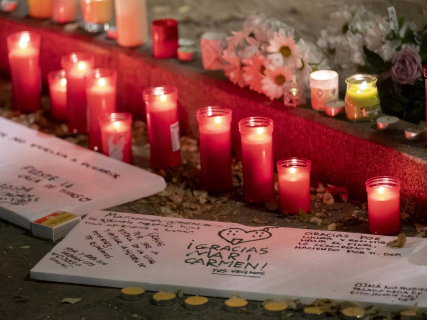
Madrid will march this afternoon for Maricarmen after a morning of tributes and political confrontation.

The Tenants' Union has called a march at 20:00 from Sol to the home from which Maricarmen Abascal was evicted. PSOE and Más Madrid have honored the woman in the Madrid institutions, while PP and Vox rejected the minutes of silence in her honor claiming political use of her death.

3 minutes

fotonoticia 20261008093741 1920

fotonoticia 20261008093741 1920

Add DEMÓCRATA to Google

Ask FREN

Published

Last updated

3 minutes

Most read

The death of Maricarmen Abascal, the 87-year-old woman whose eviction became a symbol of the protests for housing, has marked this Thursday a morning of mourning, tributes, and political accusations. For its part, as a form of reivindicative tribute, the Tenants' Union of Madrid has called for a march this afternoon that will depart at 20:00 in front of the Bear and the Strawberry Tree, in Puerta del Sol, and will head to what was her home, on Alcalde Sainz de Baranda street, in Retiro.

Maricarmen passed away on Wednesday at the Gregorio Marañón Hospital, where she had been hospitalized since the eviction on September 23. Her death occurred when an agreement had been reached for her to return to the apartment where she had lived for more than seven decades. 

A march from Sol to her house

The call from the Tenants' Union proposes to cover the path between the main stage of the housing mobilizations and the home that Maricarmen could not recover before she died. The tribute will end in front of her former house, on Sainz de Baranda, under the slogan "Fight for what is yours".

The mobilization this afternoon will continue the reaction from last night to the news of her death. After the news of the death became known, the participants in the Sol camp marched towards Congress, where they held a vigil and observed moments of silence. The protest and the return to the square took place without incidents, although there were moments of tension in front of the police presence in Cedaceros.

During the early morning, Sol was filled with candles, messages, and flowers in memory of the woman whose case prompted the camp. The square has completed its twelfth night of protest, now marked by mourning and the will to maintain the demands.

The agreement to return came too late

The possibility of returning to her home was one of the last events in the case. Maricarmen's legal representation had reached an agreement with the property, with mediation from the Municipal Housing and Land Company of Madrid, which ultimately could not be materialized before her death.

Her lawyer, Beatriz Duro, has linked the deterioration of her health to the eviction process and has argued that suspending the eviction would have prevented this outcome. The Tenants' Union has also denounced that the solution to recover her home came too late.

Tributes from the opposition and rejection of the moments of silence

The death of Maricarmen has entered this morning into the plenaries of the Madrid institutions. PSOE and Más Madrid have held a minute of silence in front of the Palacio de Cibeles in the absence of an institutional tribute at the beginning of the extraordinary session of the City Council. The two groups have also paid tribute to the deceased during the plenary, standing up and showing posters with her image.

In the Asamblea de Madrid, the socialist deputies and those from Más Madrid have observed a minute of silence in the courtyard of the Chamber after the rejection by PP and Vox to hold it before the plenary. The popular party has justified its refusal by considering that the opposition was politically using the death.

The controversy has extended to the Senate. Its president, Pedro Rollán, has rejected the request from socialist Juan Espadas to observe a minute of silence in the Permanent Deputation, citing the absence of precedents and fit for that tribute, although he has expressed solidarity with the family.

Ayuso and Almeida accuse the left of instrumentalizing her death

For his part, the mayor of Madrid, José Luis Martínez-Almeida, has accused PSOE and Más Madrid of turning Maricarmen into a "electoral strategy." During the municipal plenary, he called the left "vultures" and "scavengers." and defended that the City Council was the administration that provided social assistance and facilitated the possibility of returning to her home.

Meanwhile, the regional president, Isabel Díaz Ayuso, has blamed the government of Pedro Sánchez and socialist legislation for the eviction. In the Assembly, she contrasted the lack of "housing for women like Maricarmen" with those intended, according to her words, "for lovers like Jéssica", referring to the ex-partner of José Luis Ábalos.

From the central government, the delegate in Madrid, Francisco Martín, has directed his criticisms towards those who rejected housing measures in Congress. He stated that the parties that overturned the decrees that, in his opinion, would have prevented the eviction "have no forgiveness from God."

More key points, information and questions with FREN

AI-GENERATED CONTENT

What is the current status of the parliamentary processing of the latest reforms to the Housing Law in Spain?

As of October 8, 2026, the “latest reforms” of the Right to Housing Law (Law 12/2023) are mainly structured through a major bill from the PP still under processing and several recent royal decree-laws that have been rejected by Congress, in addition to some specific initiatives that have already lapsed. Law 12/2023 remains in force as the basic framework but has been subject to intense reformist pressure both from the Government and the opposition.

1. The PP's structural reform: the only major active initiative

The central piece right now is the Bill on administrative and procedural measures for legal certainty in territorial and urban planning, the promotion of urban development, and housing, promoted by the Popular Party:

  • It originated in the Senate (file (15)622/000057) and was sent to the Congress as a bill from the Upper House (file 124/000020).
  • The Plenary of Congress approved its consideration on April 21, 2026, with 178 votes in favor, 163 against, and 6 abstentions, according to the official note from Congress (press release of 21‑04‑2026).
  • Since then, the initiative has been processed in the Housing and Urban Agenda Committee of Congress and is currently in the amendment phase to the articles, whose deadline has been extended and was at least prolonged until October 7, 2026.

This bill is especially relevant because it incorporates a partial repeal of Law 12/2023 itself and of the Urban Leases Law (LAU). The parliamentary summary indicates, among other points, the repeal of articles 18 and 19 of Law 12/2023, several provisions on pressured zones and price indices, and adjustments in additional and transitional provisions. The committee report phase and the final vote in the Plenary of Congress, as well as its possible return to the Senate, have not yet occurred, so:

Current status: active initiative, in the phase of committee processing and submission of amendments in Congress; still far from final approval.

2. Sumar's reform attempts: all rejected

In parallel, the Plurinational Group Sumar has promoted several reforms directly aimed at strengthening the social function of housing, which have already been closed:

  • Bill to amend Law 12/2023, of May 24, on the right to housing (file 122/000251, Congress). It sought, among other things, to limit the transfer of housing to individuals, restricting residential ownership by legal entities. It was debated in the Plenary and the consideration was rejected on September 15, 2026, with 44 votes in favor, 175 against, and 127 abstentions; the processing ended and the text did not proceed to committee (BOCG, Series B, no. 300‑2).
  • A previous bill with a similar purpose (file 122/000178) was also rejected at its consideration on November 27, 2025, with 44 votes in favor, 179 against, and 124 abstentions, so it was also archived (BOCG, Series B, no. 205‑2).

In terms of parliamentary processing, none of Sumar's proposals to reform the text of Law 12/2023 remain active: all have been stopped at the first stage (consideration).

3. Recent housing royal decree-laws: rejected or included in broader bills

In the last year and a half, the Government has also intensely used the royal decree-law to modulate aspects related to the Housing Law and the rental market. From a parliamentary perspective:

  • The Royal Decree-law 26/2026, of September 29, on urgent measures for the protection of the social function of housing and the expansion of affordable housing supply (BOE‑A‑2026‑20266), included express modifications to Law 12/2023 (for example, on the definition of large holder and the regime of pressured zones). However, Congress did not validate the decree and its repeal was published in the BOE on October 2, 2026, so the reform it contained has become ineffective.
  • Other recent royal decree-laws related to housing —such as those extending the suspension of evictions or extending deadlines of the third transitional provision of Law 12/2023 (RDL 9/2024, 16/2025, 2/2026, 8/2026, 2/2026, etc.)— have followed mixed paths: some have been rejected in validation and their changes have lapsed; others have been agreed to be processed as broad bills, where housing aspects are integrated:
    • The Bill 121/000047, derived from Royal Decree-law 1/2025, which extends and adjusts protection measures in housing matters, is in Congress with the article amendment deadline still open and extended until October 7, 2026 (file 121/000047).
    • The Bill 121/000003, derived from RDL 8/2023, which also affected the third transitional provision of Law 12/2023, has already closed the amendment deadline and is pending further processing after its referral to the Plenary of Congress was agreed.

In summary, the most recent government reforms via royal decree-law have undergone a strong parliamentary filter: several have been rejected, and those that survive do so reincarnated in complex bills still in process.

4. Other housing initiatives related but not specific to Law 12/2023

Finally, there are housing initiatives that do not directly amend Law 12/2023 but do affect its normative “ecosystem”:

  • The Bill for the regulation of temporary rental contracts and room rentals (file 122/000136) passed consideration and is in Congress with the amendment phase closed and the committee already constituted, after its referral to the Plenary was agreed (BOCG, Series B, no. 154‑7).
  • Other bills on tourist apartments (122/000214) or prevention of speculation and guarantees of housing as a social good (122/000102) are also at various stages of processing, but their relation to Law 12/2023 is indirect (they develop or complete its framework rather than strictly modify it).

Therefore, if looking exclusively at reforms of Law 12/2023 itself, the picture is: a major PP reform still under processing (and at a relatively early stage), several Sumar attempts already rejected, and a package of recent housing royal decree-laws also rejected by Congress, whose contents only survive partially in broader bills still ongoing.

Can you detail which specific articles of Law 12/2023 the PP bill currently under processing intends to repeal or modify? What positions have the different parliamentary groups taken in debates on these Housing Law reforms? How do the reforms processed via bills 121/000003 and 121/000047 practically affect tenants and owners?

What are the competencies of the mayor of Madrid regarding housing and evictions according to municipal legislation?

The competencies of the mayor of Madrid regarding housing and evictions fall within the general regime of local entities (Law 7/1985, Regulating the Bases of the Local Regime), the special regime of Madrid (Law 22/2006, on Capitality and Special Regime of Madrid), and the regional local administration legislation of the Community of Madrid (Law 2/2003, on Local Administration). Added to this are the powers exercised through the Governing Board and municipal entities, particularly the Municipal Housing and Land Company (EMVS).

1. General framework of the mayor's executive power

  • According to Law 7/1985, the mayor is the president of the corporation and has the authority to direct the municipal government and administration and to direct, inspect, and promote municipal services and works. This includes services and policies related to housing and accommodation.
  • The same law grants him the competence to exercise the leadership of the Municipal Police and to grant licenses unless a sectoral law reserves them for the Plenary or the Governing Board. In housing matters, this applies to urban and activity licenses, inspections, and discipline related to construction.
  • He is also responsible for exercising judicial and administrative actions and defending the city council in matters within its competence, which includes lawsuits related to municipal housing, urban planning, or building discipline.

Many of these functions are, in theory, delegable, but Law 7/1985 establishes a group of mayoral powers that cannot be delegated (among others, directing the municipal government and administration, issuing ordinances, certain urban planning decisions, adopting extraordinary measures in serious risk situations, etc.). In practice, the strategic definition of municipal housing policy and political responsibility before the Plenary are inseparable from the figure of the mayor.

2. The mayor's role in Madrid's special organization

  • Law 22/2006 reconfigures the distribution of functions among the Plenary, mayor, and Governing Board. In this model, the mayor retains the role of highest executive authority and promoter of municipal policy, while the Governing Board becomes the highest collegiate body of executive function and administrative management.
  • In housing, this means that:
    • The Plenary sets the broad frameworks: approval of general urban planning, ordinances and regulations, forms of service management, creation of public business entities or commercial companies (such as the EMVS) and their statutes.
    • The mayor proposes and directs policy, presides over and coordinates the Governing Board, and is politically accountable before the Plenary for the execution of programs and actions in housing matters.
    • The Governing Board, under the mayor's impetus, concentrates many executive powers: approval of urban planning developments not reserved for the Plenary, specific management of housing programs, management agreements with the EMVS, and adoption of administrative measures in the urban planning field.

3. Material competencies related to housing

  • Within the framework of basic local regime legislation and Madrid regional legislation, the municipality has competencies in urban planning, housing, and management of municipal land assets. The mayor, as the executive body, directs:
    • The preparation and execution of municipal housing plans and programs, within the limits set by the Plenary and regional and state regulations.
    • The management of public land assets and other municipal goods intended for housing, according to Community of Madrid rules on disposal and destination of land and protected housing.
    • Relations with the EMVS: although the company has its own legal personality, its general policy, management assignments, and objectives regarding the public housing stock and social rental are set by municipal bodies under the direction of the mayor and the Governing Board.
  • In building police and urban discipline, the mayor:
    • Participates in the approval of urban management instruments and urbanization projects when the law attributes this to the mayoralty.
    • Directs the services that inspect compliance with licenses, order conservation works, and can initiate sanctioning or restoration proceedings of urban legality.

4. Municipal intervention in evictions

Evictions (eviction orders in rented or mortgaged homes) are, at their core, actions decided by judicial bodies based on state legislation; the mayor of Madrid does not have the power to halt or revoke judicial rulings. However, within his competencies he can:

  • Organize, through municipal social and housing services and the EMVS, care and rehousing devices for affected households, in coordination with the Community of Madrid.
  • Promote programs of alternative housing, public rental stock, and mediation with owners, companies, or financial entities, using municipal competencies in housing and social services.
  • Coordinate the Municipal Police regarding public order during evictions, always within what the judicial authority orders and respecting protocols that may exist with other security forces.

In summary, the mayor of Madrid does not decide evictions but sets and executes municipal policy that can prevent or mitigate their effects: urban and housing planning, management of the public stock, relations with the EMVS, urban discipline, and organization of social and emergency housing services.

Can you specify which decisions about the EMVS depend on the mayor and which on the Plenary or the Governing Board? What leeway does the Madrid City Council have to enact housing ordinances that indirectly influence evictions? How are municipal social services and courts coordinated in eviction procedures in Madrid in practice?

What results did the Popular Party obtain in the last regional elections of the Community of Madrid?

In the last regional elections of the Community of Madrid, held on May 28, 2023, the Popular Party (PP) obtained a very comfortable absolute majority in the Assembly of Madrid. According to official data collected from various institutional and press sources, the PP achieved approximately 47.34 % of the votes and 71 seats out of a total of 135, surpassing by a margin the 68 seats needed for an absolute majority.

This result consolidates the candidacy led by Isabel Díaz Ayuso as the hegemonic force in Madrid politics. In a parliament of 135 deputies, holding 71 means not only governing alone but also having a sufficient cushion to pass laws, budgets, and strategic decisions without relying on external support. The parliamentary arithmetic places the PP above the sum of several opposition parties in many scenarios.

From a strictly numerical point of view, the key data for the PP in those elections can be summarized as follows:

  • Election date: May 28, 2023.
  • Elected chamber: Assembly of Madrid (135 seats).
  • Party: Popular Party (PP) – Isabel Díaz Ayuso's candidacy.
  • Approximate vote percentage: 47.34 %.
  • Seat count: 71 regional deputies.
  • Absolute majority: set at 68 seats; PP exceeds it by 3.

Several subsequent analyses in specialized media highlight that these 71 seats in 2023 improve an already very solid result. In polling pieces by Demócrata and surveys from firms like GAD3 or Sigma Dos, used to compare trends, it is recalled that in 2021 the Madrid PP stood around 44.7 % of the votes and around 65-70 seats (depending on the source and reference figure), while in 2023:

  • The vote percentage rises to approximately 47.3–47.34 %.
  • Its parliamentary weight strengthens to 71 seats.
  • It transforms a narrow absolute majority into a clearly comfortable one.

This evolution explains why, in polls later in 2025 and 2026, polling institutes use these 2023 results as a reference: they talk about “expanding” or “renewing” a majority that is already very solid. For example, GAD3 has projected scenarios in which the PP could reach around 48.7 % and approach 72 or more seats, and Sigma Dos has estimated similar ranges, always starting from the 2023 base data: around 47.3 % of the vote and about 70–71 deputies. These projections do not change the actual result but help to dimension the weight of the Madrid PP in the subsequent political cycle.

Politically, the May 2023 result had several implications:

  • Single-party government: by exceeding the absolute majority threshold by three seats, the PP did not need coalition agreements for investiture or basic government stability.
  • Strengthening of Ayuso's leadership: the result has been interpreted as confirmation of Madrid as one of the main regional strongholds of the PP, along with Galicia or, more recently, some communities where the party also governs.
  • Reconfiguration of the opposition: left-wing forces were clearly behind in votes and seats, and much of the subsequent debate has focused on who leads the opposition and how to reorganize the progressive space in Madrid.

In summary, the answer to your question is that the Popular Party obtained in the last regional elections of the Community of Madrid, on May 28, 2023, around 47.34 % of the votes and 71 seats out of a total of 135, which gave it a comfortable absolute majority in the Assembly of Madrid.

Play

Test your knowledge with FREN!

How much do you know about this topic? Answer the following 3 questions.

Which organization has called the march in tribute to Maricarmen Abascal after her death?

Question 1 of 3

What was the reason for the political confrontation between parties after Maricarmen's death?

Question 2 of 3

What event happened after Maricarmen's death was known at Puerta del Sol?

Question 3 of 3